

To detect lab-grown diamonds reliably, you need a dedicated diamond detection machine. A loupe or a normal thermal tester cannot do it, because CVD and HPHT diamonds are real diamonds. This guide explains where lab-grown stones enter a jewellery business, why common tests miss them, and a simple daily routine that catches them.
What is a lab-grown diamond?
A lab-grown diamond is made of carbon, just like a natural diamond. It has the same hardness, the same sparkle and the same chemistry. The only difference is where it was formed: in a factory over weeks, not in the earth over millions of years.
There are two main ways to grow one:
- CVD (Chemical Vapour Deposition): carbon gas builds the diamond layer by layer on a small seed.
- HPHT (High Pressure, High Temperature): carbon is pressed and heated until it turns into diamond, copying conditions deep in the earth.
Both are legal and can be sold, as long as they are disclosed. The problem starts when they are mixed into natural goods without anyone knowing.
Natural vs CVD vs HPHT vs CZ at a glance
| Stone | What it is | Passes a normal diamond tester? | Price compared with natural |
|---|---|---|---|
| Natural diamond | Formed in the earth | Yes | Full price |
| CVD diamond | Lab-grown, layer by layer | Yes | Much lower |
| HPHT diamond | Lab-grown under heat and pressure | Yes | Much lower |
| CZ / AD (cubic zirconia) | Not a diamond, an imitation | No | Very low |
The table shows the real risk. A normal tester catches CZ, but CVD and HPHT pass as diamond.
Where lab-grown diamonds usually slip in
Mixing rarely happens in large certified stones. It happens where checking is hardest:
- Melee and small parcels. Hundreds of tiny stones are too many to check one by one under a loupe.
- Studded jewellery. Rings, pendants, bangles and earrings carry many small stones set close together. Removing them for testing is slow and risky.
- Old gold and exchange schemes. Jewellery coming back from customers or other dealers has no clear history.
- Repairs and re-setting. One stone replaced during a repair can change what a piece is worth.
- New or unverified suppliers. Their parcels carry the highest risk.
If your business touches any of these five areas, screening is no longer optional.
Why a normal diamond tester cannot detect lab-grown diamonds
Most handheld diamond testers measure how fast a stone carries heat or electricity. That is enough to tell a diamond from glass or CZ.
It is not enough to tell natural from lab-grown. CVD and HPHT stones are real diamonds, so they pass these tests easily. A green light on a pen tester gives a false sense of safety.
To separate natural from lab-grown, you need a lab-grown diamond tester built to screen stones by diamond type.
How to detect lab-grown diamonds: a 3-step routine

You do not need a gemology lab inside your shop. You need a routine your team follows every day.
Step 1: Screen everything that comes in. Put every incoming parcel and every studded piece through a detection machine before it enters stock. Make it a rule, especially for melee, exchange jewellery and new suppliers.
Step 2: Separate the results. The machine sorts stones into Natural, CVD, HPHT or CZ. Natural stones go to stock. Anything flagged goes into a separate, labelled packet.
Step 3: Confirm and act. Send flagged stones to a laboratory for certification. Then return them to the supplier, or disclose them correctly to your customer.
Done daily, this takes a few minutes. It protects your margin, your reputation and your customers’ trust.
7 things to check before buying a CVD diamond detection machine
- Detection range: it should separate Natural, CVD, HPHT and CZ, not just say diamond or not.
- Smallest stone size: most mixing happens in melee, so small-size screening matters.
- Colour range: check which colour grades it supports, for example D to K.
- Loose and studded: can it test jewellery without removing the stones?
- Speed and capacity: how long one scan takes, and how many stones it covers at once.
- Ease of use: can counter staff run it without gemology training?
- Service and support: look for low maintenance and a service team close to you.
A machine that passes all seven becomes part of the daily workflow, not a device kept in a cupboard.
Which Vedant Techvision machine fits your business?
Vedant Techvision in Surat builds machines for each kind of diamond business. All three detectors below separate Natural, CVD, HPHT and CZ diamonds in the D to K colour range.
| If you work with… | Best fit | Why |
|---|---|---|
| A retail counter, or you travel to clients | MiniSure | Compact and phone-controlled. Tests loose and studded stones from 0.002 ct in 45 to 60 seconds, and also detects moissanite. |
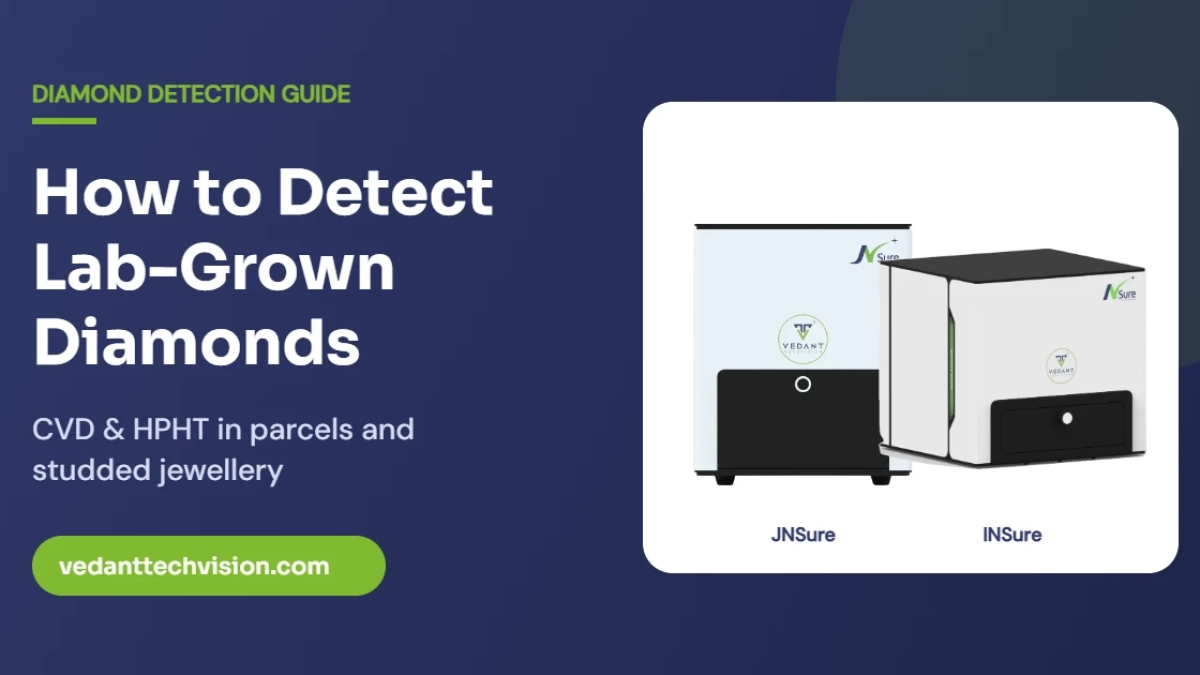
| A showroom, jewellery factory or lab | JNSure | Large scan area with trays for many rings or bangles at once. Screens stones from 0.002 ct. |
| Loose diamond parcels in volume | INSure | Screens thousands of loose diamonds per hour, all shapes, from 0.003 ct. |
Need to sort stones by size after screening? DiaMetric measures each diamond in under a second and tells the operator which size box it belongs in. You can compare all machines on our products page.
Frequently asked questions
Can a normal diamond tester detect lab-grown diamonds?
No. A thermal tester confirms that a stone is a diamond, but CVD and HPHT diamonds are real diamonds too. You need a dedicated detection machine to separate them.
How can I identify a CVD diamond?
A CVD diamond looks the same as a natural one to the eye and under a loupe. The reliable way is to screen it on a CVD diamond detection machine, then send flagged stones to a lab for a certificate.
Can studded jewellery be tested without removing the stones?
Yes. MiniSure and JNSure screen stones while they are still set in rings, pendants, bangles and other jewellery.
How small a diamond can be screened?
MiniSure and JNSure screen from 0.002 carat, and INSure from 0.003 carat. That covers most melee used in jewellery.
How long does one scan take?
Between 45 and 90 seconds, depending on the machine. Each scan covers many stones at once.
What should I do with a stone flagged as CVD or HPHT?
Keep it separate and send it for laboratory certification. Then return it to the supplier or disclose it correctly before any sale.
See it work on your own stones
The diamond trade has always run on trust. Today, that trust needs proof, and screening every stone takes only a few minutes a day.
Book a free live demo with Vedant Techvision. Call +91-7433981000 or email Sales@vedanttechvision.com (Monday to Saturday, 9:30 AM to 7:00 PM). Or contact us here.


 306-307,Apple square, Near Ashish restaurant Gajera School Circle, Katargam, Surat, India.
 support@vedanttechvision.com