

Lab-grown diamonds are now part of almost every diamond lot that changes hands. For a jeweller, manufacturer or trader, a CVD diamond detection machine is no longer optional. It is the only practical way to know that natural goods are really natural. But machines differ a lot in speed, minimum stone size, scanning area and ease of use. This guide explains how to choose the right CVD diamond detection machine for your business and where INSure, JNSure and MiniSure by Vedant Techvision fit.
Why you need a CVD diamond detection machine
CVD (Chemical Vapour Deposition) and HPHT (High Pressure, High Temperature) diamonds are real diamonds grown in a lab. They have the same hardness and sparkle as natural diamonds, so a loupe or a normal thermal tester cannot tell them apart. When they are mixed into natural parcels or set in jewellery without disclosure, the business that sells them carries the risk.
A dedicated CVD diamond detection machine screens stones and separates natural diamonds from CVD, HPHT and CZ, so suspicious stones can be set aside before they are bought, sold or set.
6 things to compare before you choose a CVD diamond detection machine
- What it detects: make sure it identifies natural, CVD, HPHT and CZ, not only one type.
- Minimum stone size: small stones are where lab-grown diamonds are easiest to hide. The smaller the minimum size, the better.
- Colour range: check which colour grades the machine supports. D to K covers most commercial goods.
- Scanning time: faster scans mean more stones checked per day.
- Scanning area: a bigger area screens more stones or jewellery pieces in one scan.
- Daily use: look for simple operation, low maintenance and no complicated setup.
INSure: CVD diamond detection for natural, CVD, HPHT and CZ
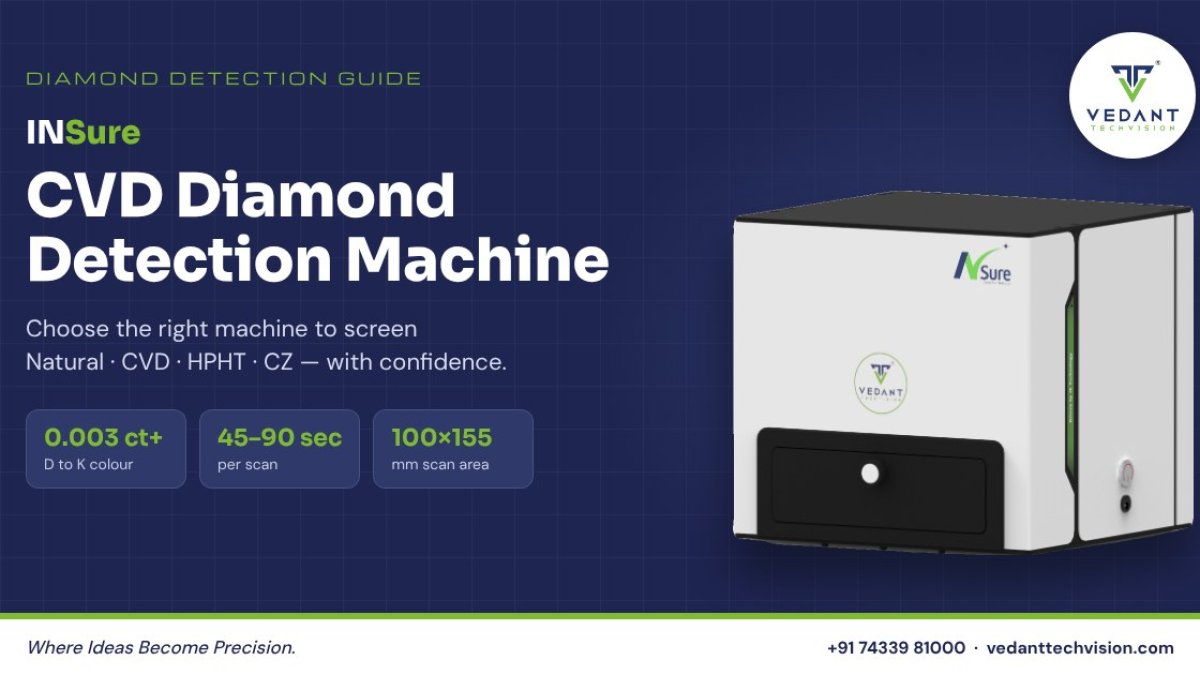
INSure is a CVD diamond detection machine by Vedant Techvision. It identifies natural, CVD, HPHT and CZ diamonds and is built for businesses that need dependable daily screening.
- Detects: natural, CVD, HPHT and CZ diamonds.
- Minimum size: 0.003 carat and larger.
- Colour range: D to K.
- Scanning time: 45 to 90 seconds.
- Scanning area: 100 × 155 mm.
INSure, JNSure and MiniSure compared
Vedant Techvision makes three CVD diamond detection machines. All three identify natural, CVD, HPHT and CZ diamonds. Here is how they compare:
| Specification | INSure | JNSure | MiniSure |
|---|---|---|---|
| Detects | Natural, CVD, HPHT, CZ | Natural, CVD, HPHT, CZ | Natural, CVD, HPHT, CZ |
| Minimum size | 0.003 ct | 0.002 ct | 0.002 ct |
| Colour range | D to K | D to K | D to K |
| Scanning time | 45–90 sec | 45–90 sec | 45–60 sec |
| Scanning area | 100 × 155 mm | 225 × 175 mm | 100 × 100 mm |
| Best for | Dependable daily screening | High-volume loose and studded screening | Small counters and travel |
Which CVD diamond detection machine is right for you?
- Choose INSure if you want a dependable CVD diamond detection machine for regular screening of natural, CVD, HPHT and CZ stones.
- Choose JNSure if you screen large batches of loose diamonds and studded jewellery. Its 225 × 175 mm scanning area and trays for up to 45 rings make it ideal for factories and wholesalers. Read our guide to the studded jewellery diamond tester.
- Choose MiniSure if you need a compact machine that runs from a mobile app, for a small counter or for travel. Read our guide to the portable diamond tester.
Not sure where to start? Our guide on how to detect lab-grown diamonds explains the basics, and all machines are listed on our products page.
A simple screening routine with any machine
- Screen everything that comes in: new parcels, old gold exchange pieces and goods from new suppliers.
- Set aside flagged stones: keep any stone marked CVD, HPHT or CZ separate and labelled.
- Confirm before you decide: for high-value stones that are flagged, send them to a gem lab for a full report.
Frequently asked questions
What does a CVD diamond detection machine do?
It screens diamonds and separates natural diamonds from lab-grown CVD and HPHT diamonds and from CZ, which a normal diamond tester cannot do.
What is the smallest diamond INSure can screen?
INSure screens diamonds of 0.003 carat and larger, in D to K colour.
How long does an INSure scan take?
One scan takes 45 to 90 seconds.
What is the difference between INSure, JNSure and MiniSure?
All three detect natural, CVD, HPHT and CZ. JNSure has the largest scanning area for high volumes, MiniSure is the most compact and runs from a mobile app, and INSure is built for dependable daily screening with a 100 × 155 mm scanning area.
Can I see the machines before buying?
Yes. You can book a demo at our Surat office and test the machines on your own stones.
Book an INSure demo
The best way to choose a CVD diamond detection machine is to watch it scan your own goods. Call +91-7433981000, email Sales@vedanttechvision.com or contact us here to book a demo.


 306-307,Apple square, Near Ashish restaurant Gajera School Circle, Katargam, Surat, India.
 support@vedanttechvision.com