

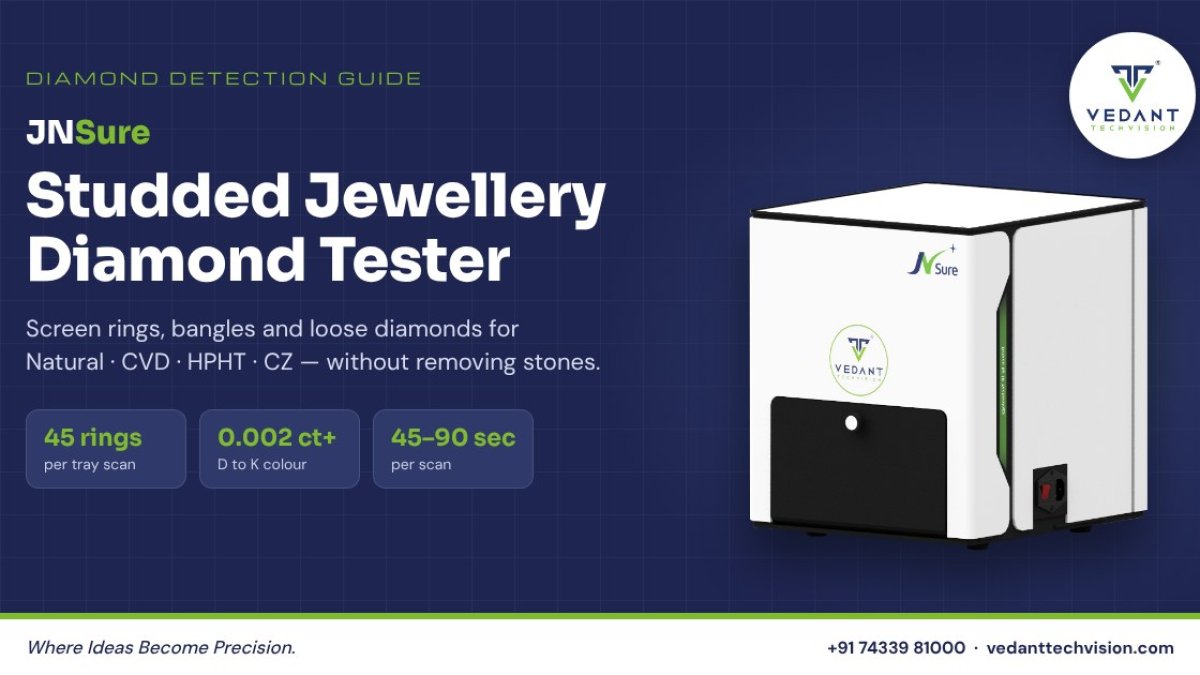
Checking loose diamonds is one job. Checking a tray of finished rings, bangles and pendants is a very different one. A studded jewellery diamond tester has to scan small stones that are already set in gold, at different heights, with metal around them, and it has to do this fast enough to keep up with a real counter or factory. This guide explains why studded jewellery is hard to screen, what to look for in a machine, and how JNSure by Vedant Techvision handles it.
Why studded jewellery is harder to screen than loose diamonds
When stones are loose, you can lay them flat on a tray and scan them in one go. Once they are set, three problems appear:
- Different heights: a ring shank, a bangle and a pendant all hold stones at different levels, so the machine has to focus on each one correctly.
- Very small stones: pavé and side stones are often well below 0.01 carat, and these are exactly where lab-grown diamonds are easiest to mix in.
- No removing stones: taking stones out of finished jewellery to test them is slow, risky and costly. The test must work with the stones still set.
A normal thermal diamond tester does not solve this. CVD and HPHT stones are real diamonds, so a thermal tester simply says “diamond”. To separate natural from lab-grown in set jewellery, you need a dedicated studded jewellery diamond tester.
What a good studded jewellery diamond tester must do
Before you buy any machine for jewellery screening, check these points:
- Detects all four types: natural, CVD, HPHT and CZ, not just one.
- Works on loose and studded: one machine for parcels and for finished pieces.
- Small minimum size: it should screen tiny side stones, not only centre stones.
- Automatic focus and height: so staff do not have to adjust anything for each ring or bangle.
- Large scanning area: more pieces per scan means more pieces per hour.
- Proper trays: ring and bangle trays that hold jewellery steady and in order.
- Low maintenance and simple to use: it should run every day without a technician.
How JNSure works as a studded jewellery diamond tester
JNSure is a CVD detection machine designed to identify natural, CVD, HPHT and CZ diamonds in both loose stones and studded jewellery. It is built for the exact situation described above: many pieces, many stone sizes and no time to waste.
Large scanning area with jewellery trays
JNSure has a 225 × 175 mm scanning area. It comes with a loose diamond tray (200 × 250 mm), a ring tray that holds up to 45 rings and a bangle tray with space for 10 bangles. That means a full tray of rings can be screened together instead of one by one.
Automatic focus and height adjustment
Its software includes auto-focus and automatic height adjustment. Staff place the tray and start the scan. There are no manual adjustments for different jewellery heights.
Small stones and wide colour range
JNSure screens diamonds from 0.002 carat and larger, in D to K colour grades. This covers the small side stones that matter most in studded jewellery.
Results in 45 to 90 seconds
Each scan gives results in 45 to 90 seconds, so a counter or QC desk can check a full batch of jewellery without slowing down the business.
Made for daily use
JNSure is a self-contained, plug-and-play system with no extra calibration tools needed. It is designed for low maintenance and silent operation, so it fits in a showroom, a manufacturing unit or a lab.
JNSure specifications
| Specification | JNSure |
|---|---|
| Detects | Natural, CVD, HPHT and CZ |
| Works on | Loose diamonds and studded jewellery |
| Minimum size | 0.002 carat and larger |
| Colour range | D to K |
| Scanning time | 45 to 90 seconds |
| Scanning area | 225 × 175 mm |
| Dimensions | 344 × 308 × 355 mm |
| Weight | 18 kg |
| Trays included | Loose diamond tray, ring tray (up to 45 rings), bangle tray (up to 10 bangles) |
Who should use JNSure?
- Jewellery manufacturers: to check finished pieces before they leave the factory.
- Jewellery showrooms: to screen incoming stock and old gold exchange pieces.
- Wholesalers and traders: to verify large lots of studded jewellery quickly.
- Testing labs: to handle high volumes of both loose and studded goods.
JNSure or MiniSure: which one fits you?
Both machines detect natural, CVD, HPHT and CZ in loose and studded diamonds from 0.002 carat. The difference is volume and size:
- Choose JNSure if you screen large batches. Its bigger scanning area and trays for 45 rings or 10 bangles suit factories, wholesalers and busy showrooms.
- Choose MiniSure if you need a compact machine for a small counter or for travel. It is smaller, lighter and runs from a mobile app.
To learn the basics of lab-grown screening first, read our guide on how to detect lab-grown diamonds, or see all machines on our products page.
Frequently asked questions
Can JNSure test diamonds without removing them from jewellery?
Yes. JNSure screens diamonds while they are still set in rings, bangles and other studded jewellery.
How many rings can JNSure scan at once?
The ring tray supplied with JNSure holds up to 45 rings, and the bangle tray holds up to 10 bangles.
What is the smallest diamond JNSure can screen?
JNSure screens diamonds of 0.002 carat and larger, in D to K colour.
How long does one JNSure scan take?
One scan takes 45 to 90 seconds.
Does JNSure need calibration tools or a technician?
No. It is a self-contained, plug-and-play system with an easy software interface, designed for non-technical staff.
Book a JNSure demo
The best way to judge a studded jewellery diamond tester is to see it scan your own jewellery. Call +91-7433981000, email Sales@vedanttechvision.com or contact us here to book a demo at our Surat office.


 306-307,Apple square, Near Ashish restaurant Gajera School Circle, Katargam, Surat, India.
 support@vedanttechvision.com